.png)
How Behavioral Health Coaches Are Actually Using AI — Part 1
- Tzur Barak
- Jun 24
- 9 min read
A practical field guide to how the coaching industry is adopting AI — and where it’s headed.
Over the past few weeks I set out to answer one question as honestly as I could: where is AI actually useful in a behavioral health coaching practice, where is it already being used, and what are the real opportunities and risks it brings?
To get there I went through the published research and studies from the leading coaching organizations, did one-on-one talks with practicing coaches, and looked closely at the tools they rely on. (More on the method at the end.)
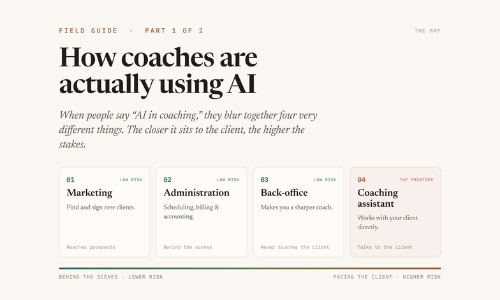
The first thing worth saying: when people talk about “AI in coaching,” they blur together four very different things. It helps to keep them separate.
Marketing — using AI to find and sign new clients.
Administration — using AI to run the operational side: scheduling, billing, accounting.
Coaching back-office — using AI to make you better at the actual coaching, without it ever touching the client directly.
Coaching assistant (emerging) — AI that interacts with your client directly, on your behalf.
The first three are already here: mature, proven, low-drama. The fourth is the frontier — and it’s important enough that I’ve given it its own article (Part 2), because I found it to be both the most transformative and the most risky shift coming to the practice.
Before I get into the four domains and the practical how-to, I want to share a few things that jumped out while gathering the numbers.
The ICF’s (International Coaching Federation) 2025 Global Coaching Study draws on more than 10,000 practitioners across 127 countries, and raises a few highlights about tech and AI:
The profession is enthusiastic, anxious, and inexperienced, all at once. Over half of coaches now treat better platforms and AI-driven tools as a priority — yet only about 6% are actually using AI-powered coaching tools, and roughly 37% name adapting to technology as one of their top concerns for the year ahead.
Tech is going mainstream for virtual work and scheduling. 47% of coaches now use digital coaching platforms — mainly for one-on-one virtual sessions (35%) and scheduling and client management (23%).
The horizon is much more tech-heavy. In 2025, 19% of coaches invested in new technology; that’s set to rise to 27% over the next one to three years.
The tools coaches actually rely on
Looking at usage and review data on G2 and Capterra, one thing stands out: the tools coaches actually rely on are, by and large, well-reviewed and battle-tested. That matters, because it means you’re not being asked to gamble on unproven software. The headline numbers:
Transcription / notes: Fathom holds a remarkable 5.0/5 on G2 across more than 6,000 reviews; Fireflies sits around 4.8/5; Otter around 4.4/5 across hundreds of reviews on both G2 and Capterra, with over a billion meetings captured.
Practice management (the back-office hub): Practice Better carries roughly 4.8/5 on G2 across ~290 reviews, with entry pricing near $35/month; Healthie sits around 3.9/5 (smaller review base, recently pivoting toward enterprise/API). Both are widely used in nutrition and wellness coaching.
Scheduling and general AI (Calendly, Acuity; ChatGPT, Claude, Gemini) are too broadly adopted to need defending — the question isn’t whether they work, it’s how you use them.
The core things to know about the 4 working domains to get more AI into your workflow:
Marketing
What you need to know
This is the most common place coaches start, and the lowest-stakes. Most use general AI tools to generate content ideas, turn real insights from their work into posts and emails, and draft replies to inquiries. If you regularly publish — a newsletter, posts, articles — this is a real breakthrough: the time it takes to produce a solid piece of content drops to a fraction of what it used to be. And if you’re a practitioneur (a solo practitioner building a business on your own), you know how hard it is to show up consistently. AI removes a lot of the friction that stops most coaches from publishing at all.
Critical Insights: treat AI as a starting structure, a first draft, an idea generator, not a finished product. In a field where people are buying your judgment and your way of seeing the world, that difference is everything.
How to step into it
Start narrow. Pick one recurring task — say, turning each client win or insight into a short post — and build a repeatable prompt for it. Feed the AI your own past writing so it learns your voice instead of defaulting to generic AI cadence. Use it to expand and structure your raw thinking. Once it gives you a draft, rewrite it in your own words — ideally let someone who knows you read it and tell you whether it still sounds like you — then go public.
Then measure. Most coaches don’t track how their marketing actually performs — it used to be a game only for people who could outsource it or hire a pro. That’s no longer true. Start simple: ask any of the general AI tools to walk you through setting up basic tracking. If you see value, move on to dedicated analytics tools, or set up a simple AI helper to do it for you.
What to be cautious of
Generic AI content is a liability dressed as a convenience. Audiences can’t always name what’s off, but they feel it. Over time, the tool you brought in to build trust starts quietly eroding it. The principle here: stay the author. AI is your co-writer, never a ghostwriter. The moment your content sounds like everyone else’s, you’ve traded the one thing that actually wins clients for a little saved time.
Administration: the easiest, safest win
What you need to know
If you do nothing else with AI, start here. This is where AI returns clean, low-risk hours, because clients and prospects mostly never see it. There’s a small learning curve, but the return is big: it takes the scheduling, billing, and accounting off your plate — all that work that quietly keeps a practitioneur away from the creative, fulfilling part of coaching.
There are two ways to bring AI into your admin work:
Through general AI assistants (ChatGPT, Claude, Gemini) — most useful if your admin already runs on Microsoft or Google tools, which these can now connect to.
Through admin tools that have AI built in — scheduling tools like Calendly for booking and reminders, or all-in-one practice-management platforms that bundle intake, programs, billing and a client portal (Practice Better and Healthie are common in nutrition; Paperbell, CoachAccountable, Quenza, and Satori across coaching).
Critical Insights: this is the most defensible use of AI in the whole practice. It saves real time, cuts the no-shows and admin drag that quietly eat a solo coach’s week, and because it runs behind the scenes, it carries almost no relationship risk. The strong review scores above tell you these are safe bets, not experiments.
How to step into it
Pick your single biggest time sink first. For most coaches it’s either scheduling back-and-forth (fixed by a booking tool) or post-session notes (fixed by a transcription/summary tool). Get one working fully before you add another — tool sprawl is a real cost. If you’re starting the practice-management layer from scratch, the all-in-one platforms replace four to six separate subscriptions, which is usually worth the switching effort. Try the free tiers (Fathom and Healthie both offer generous ones) before committing.
What to be cautious of
Privacy is the one real risk, and in behavior-change work it’s not trivial — a lot of what your clients share is sensitive. The moment that information flows through general-purpose AI tools that weren’t built to protect it, you’ve taken on a data-handling responsibility most coaches haven’t thought through. The fix isn’t to avoid the tools; it’s to choose ones that are explicit about how they store and protect client data (look for the compliance certifications the practice-management platforms advertise), and to keep the most sensitive details out of the general AI tools. The second thing you should be aware of is the scattered, defocused workflow that comes from running too many tools. Six subscriptions that each save ten minutes can cost you more in overhead and context-switching than they give back.
Coaching back-office: AI that makes you a better coach, invisibly
What you need to know
This is the most under-used high-value area, and the one I’d most encourage cautious coaches to explore. Here the AI never touches the client. It works for you: summarizing sessions, drafting the follow-up, building tailored resources, doing background research on a client’s specific situation, spotting patterns across weeks of notes you might otherwise miss. All of it happens behind the scenes, so you walk into the session more prepared and free to give your full attention, and to bring more of who you are to your client.
Critical Insights: you review everything, and nothing reaches the client without passing through your judgment. You become sharper and more prepared without changing anything the client experiences. Of all four areas, this is the highest reward for the lowest relational risk.
How to step into it
Build it into your existing session rhythm. After each session, have your transcription tool generate the summary, then ask an AI to pull out the two or three things worth following up on and draft the follow-up message for you to edit. Before each session, ask it to surface what’s changed since last time. Keep a running, AI-assisted view of each client’s arc. The whole point is leverage on your preparation, so the client gets a more focused you.
Most enabling tools here generate modern transcriptions that turn a recorded session into a structured summary in seconds (Fathom, Otter, Fireflies, Granola).
What to be cautious of
Once AI is reading and drawing insights from your client’s personal details, you’re carrying real personal and professional risk. Data-protection rules (GDPR, HIPAA and others) restrict exposing that kind of information to general-purpose AI, so, as with the admin tech, work only with tools that have data protection built in (look for the compliance certifications these tools provide).
The second risk is over-dependence. This profession demands that you keep evolving and sharpening your own thinking. If you stop forming your own thoughts and hand that over to an AI, you start outsourcing the very judgment clients are paying for. Use it to surface and organize ideas, not to think for you.
Coaching assistant: the frontier (the focus of Part 2)
What you need to know
A coaching assistant is different in kind, not just in degree. Here the AI interacts with your client directly, between sessions, on the client’s schedule, running a designed daily practice that keeps a program alive when you’re not in the room. There are real reasons this category is being built (full disclosure: my own company is working on a solution in this space): it lets a practitioner reach more people, be available around the clock, and run daily touchpoints that are almost impossible to deliver with the current one-on-one model. This is where adherence finally has a chance, because adherence breaks precisely in the gaps between sessions, exactly where you can’t be right now.
This is already being built in a few behavior-change verticals, and the early signals are encouraging — the approaches that pair AI with a human coach, rather than replacing the coach, appear to hold onto clients best. But it’s also where every serious risk concentrates, from the client relationship to genuine safety questions. It’s too important, and too risky, to cover in a paragraph. I’ll dive into more of it in the coming article (Part 2), which will discuss the two ways a co-pilot actually helps, how adoption differs across clients and practices, and how to do it without losing the relationship that makes your work work.
How to step into it
Carefully, and deliberately — which is exactly what Part 2 is for. The short version: this isn’t an all-or-nothing choice, and the version that works keeps you supervising it, not replaced by it.
What to be cautious of
Everything that makes the first three areas low-risk inverts here, because the client is now interacting with the AI without you in the room. That’s not a reason to avoid it — the upside is too large — but it is a reason to treat it as its own deliberate decision, with eyes open.
How this was researched, and the sources
I built this to be a trustworthy starting point, not a hot take. How I did it:
Research and professional surveys from the last three years, read with AI assistance to cover far more ground than a manual review allows — coaching-industry studies, peer-reviewed behavior-change research, and digital-health evidence.
Nine one-to-one interviews with practicing behavior-change coaches across verticals, kept anonymous so they could speak candidly about what’s working and what isn’t.
Product and user reviews on the platforms where practitioners rate the tools they use — G2, Capterra, GetApp — to ground the assessments in real experience rather than vendor marketing.
Key sources referenced:
International Coaching Federation — 2025 Global Coaching Study; ICF AI Coaching Framework & Standards and client-protection guidelines.
Peer-reviewed behavior-change and digital-coaching research (Mayo Clinic Proceedings; Frontiers in Psychology and Frontiers in Digital Health, 2024–2025).
Tool review data from G2 and Capterra (Fathom, Otter, Fireflies, Practice Better, Healthie, and others), as of mid-2026.

Comments