.png)
How Behavioral Health Coaches Are Actually Using AI - Part 2
- Tzur Barak
- Jul 2
- 8 min read
What happens when AI works with your client, not just for you — and how to do it right.
Picking up where Part 1 left off
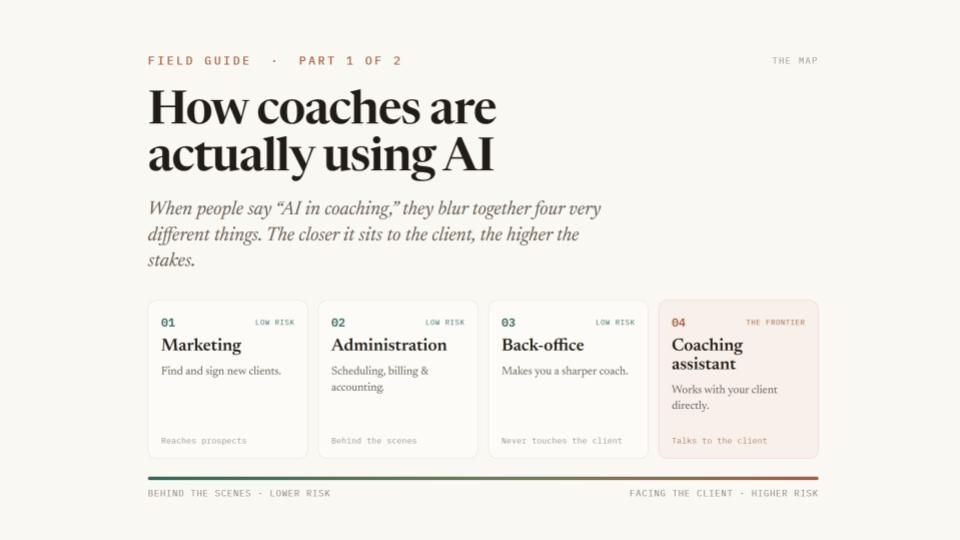
In Part 1, I mapped the three places AI has already settled into a coaching practice: marketing, administration, and coaching back-office. All three share one comfortable property, the AI never touches the client directly. This piece is about the fourth area, the one that breaks that rule and changes everything: the Coaching Assistant, AI that interacts with your client directly, between your sessions.
This is the frontier, and I want to point out why it matters so much. The entire difficulty of behavior-change work is that change happens or fails in the gaps. Between sessions. At 9 p.m. on a Tuesday, three days after you last spoke, when the work plan is clear for the client but the motivation is gone and you are not in the room. People rarely fail protocols because they don’t know what to do; they fail to sustain the work. The Personal Assistant is the first tool that can reach into those gaps. That’s a real breakthrough, and it brings its own risks that need to be mapped. (Full disclosure, same as in Part A: my own company is building in this space. I’ve worked to keep this guide as honest about the risks as it is about the upside.)
The same research approach behind Part 1 sits behind this one: three years of research and professional surveys read with AI assistance, nine practitioner interviews, and close analysis of product and user reviews. The full breakdown is at the end.
Personal AI Assistants are doing two distinct jobs
“AI coaching assistant” sounds like one thing. In practice it does two very different jobs, and keeping them separate is the key to using implementing it successfully:
Daily practice support — the assistant job is to actively help the client do the daily work: guiding the designed practices, check-ins, exercises, and small actions a program is made of, day by day.
Between-session availability — the assistant job here is to simply be there, 24/7, when the client needs to ask, vent, or steady themselves at a moment that doesn’t fit a calendar.
The first is structured and proactive, it pushes. The second is responsive and on-demand, it waits. Most of the promise, and most of the failure modes, come from how well you separate and design these two. An assistant that’s available but has no structure becomes a chatbot that feels warm but never really engages the client. An assistant that's pushing all day with no human-like responsiveness becomes a notification machine people mute.

What the real-world products actually show
Here are some hands-on insights from what’s actually happening in this field. :
The upside signal is genuine. Across the behavior-change assistant products that have reached scale, the single most-cited client benefit is the same: something is there at the moment they need it, without booking a slot or waiting a week. And the outcomes point the same way. One 2025 review of AI behavioral-coaching programs found client retention ranging from roughly 57% to 92%, with the strongest numbers in programs that pair AI with a human, not AI alone. In the market itself, a leading alcohol-moderation product reports hundreds of thousands of users and around a 30% reduction in drinking within the first month. (These product figures are largely self-reported and should be read as directional, not precise)
There is also a downside signal, I want you to know it. This is where the assistants stop being a feature and become an ethical decision. In November 2025 the American Psychological Association issued a formal health advisory warning that consumer AI chatbots and wellness apps currently lack the evidence and regulation to ensure user safety. A 2025 Stanford study found AI chatbots failed to respond safely to crisis situations roughly 20% of the time, versus about 7% for human therapists. A Brown University team catalogued fifteen distinct ways AI “counselors” violate basic ethical standards. And regulators have started moving: Illinois banned AI therapy outright in August 2025.
One important caveat, coming out of these findings: these were all generic, autonomous AI used as an unsupervised stand-in for care. The products that actually work are the opposite — hybrid AI assistants that keep a human in the loop. Across the field, the successful AI assistants do the daily, scaled, between-session touchpoints and the human practitioner is there to build the trust and do the real insights and transformational work. The professional bodies agree: the ICF’s published position is that AI should support, not replace, the human core of the work. The line is clear, an AI assistant that extends you is powerful; an AI that replaces you has real low value.
Mode 1 — The Daily Practice Assistant
WHAT YOU NEED TO KNOW
The assistant’s most valuable and most under-appreciated job is helping the client actually do the program between sessions. Not chatting, guiding. Walking them through the designed daily practice, prompting the small action, running the check-in, holding a protocol of a multi-week arc so the work continues without you having to be present for every step. This is where adherence is reached, it's where your methodology turns from something the client remembers once a week into something they actually do every day.
Critical Insights: the products that get this right are the ones that manage to anchor every interaction to a structure and defined arc with a beginning, middle, and end. From the client perspective day 12 feels different from day 2. Doing this right means to prevent the “great in week one, hollow by week four” which kills open-ended AI support. The practitioner methodology is the spine; the AI is the delivery tool.
HOW TO STEP INTO IT
Start by encoding one of your existing programs, a structured 7-, 21-, or 30-day protocol you already run, rather than inventing something new for the AI. Define the daily touchpoints, the practices, and the moments where you want to personally step in. Run it with a small handful of willing clients first, watch where the AI’s guidance drifts from how you’d actually coach, and correct it. Treat the first cohort as a design partnership, not a launch.
WHAT TO BE CAUTIOUS OF
Notification fatigue is the universal failure mode: the same daily mechanic that drives change also burns people out, and “too many messages” is the most common complaint across every product in this space. Build in cadence control from day one, let the frequency flex by client and by stage of the program, and design the assistant to back off when a client is disengaging rather than pushing harder. The second caution: don’t let the daily practice become generic. If the encoded version feels like any-coach instead of you, clients notice, and a depth gap will show.
Mode 2 — Always-Available Assistant
WHAT YOU NEED TO KNOW
This is the always there assistant. His job is to be available when the client needs it. The value is emotional and practical at once, the client is no longer alone in the hard moments between sessions, his small emotional dips get caught before they become relapses or quits. The most-loved property of these products, consistently, is exactly this: it’s there at 9 p.m or 3 a.m.
Critical Insights: 24/7 availability is genuinely powerful and genuinely double-edged, and the difference is entirely about supervision and boundaries. Done well, it extends your reach into the moments you could never cover. Done poorly, it becomes an unsupervised AI alone with a vulnerable person in a hard moment, precisely the scenario the research warns about.
HOW TO STEP INTO IT
Define the boundaries before you turn it on. Decide, explicitly: what the co-pilot handles on its own, what it escalates to you, and how a client in genuine distress is routed to real human help fast. The escalation design is not a nice-to-have — it’s the thing that makes 24/7 availability safe. Start with clear scope (“here’s what I can help with anytime; here’s when I’ll bring in your coach”) and make the handoff to you, or to a crisis resource, frictionless and obvious.
SUGGESTED
This is the highest-stakes use of AI in your entire practice, and the safety evidence is unambiguous: generic, autonomous chatbots handle crisis moments badly. Never let between-session availability become an unsupervised stand-in for care, especially in verticals touching mental health. Build the escalation path first, set clear limits on what the AI will attempt, and keep a human reachable for the moments that matter. The 24/7 promise is only as good as the safety net that comes with it.
Who actually adopts this, and who doesn’t
An assistant is not for every client or every practice, and pretending otherwise is how trust gets lost. Three patterns are worth naming.
It varies by client. Some clients embrace an always-available AI assistant immediately, they’re the ones who were already texting you between sessions, who want momentum, who find daily structure motivating rather than smothering. Others want a clean boundary: their coaching is the session, and a between-session AI feels like an intrusion or a downgrade. Neither is wrong. The practical move is to offer the assistant as an option, not a default, and let clients opt into the level of contact that fits them.
It varies by practice type. The right assistant looks different across verticals, and this is where the work genuinely differs. In some practices, daily structured practice is the whole point and clients expect it. In others, especially anything touching more sensitive territory, the bar for letting AI interact with clients directly is, and should be, much higher, with the human kept far more central. The same tool, deployed identically across different practices, will succeed in one and damage another. Match the co-pilot’s role to what your specific work actually needs.
Why AI assistants may reshape the whole practice.
An AI assistant doesn’t just add a feature; it changes the shape of the business. It can lift the hard ceiling on how many clients one coach can serve well, because the daily delivery no longer depends entirely on your time. It can shift what a “session” is for, from delivering content to handling the judgment and relationship moments the AI can’t. And it can change what clients pay for, and how. Those are significant changes, with real upside and real trade-offs, as with many innovative new steps this will take off with practitioners and verticals that are most suited and the value is clear and immediate for them. The learning and the maturation will open it up for more practitioners and more verticals.
How this was researched, and the sources
Same rigor as Part 1, because the stakes here are higher:
Research and professional surveys from the last three years, read with AI assistance — coaching-industry studies, peer-reviewed behavior-change and digital-health research, and the safety literature on AI in mental-health-adjacent contexts.
Nine anonymous one-to-one interviews with practicing behavior-change coaches, several of whom have tried client-facing AI directly — including those who adopted it and those who pulled back.
Analysis of product and user reviews of the real client-facing AI products in this space, on G2, Capterra, GetApp and the app stores, to ground the upside and the failure modes in actual user experience.
Key sources referenced:
International Coaching Federation — 2025 Global Coaching Study; ICF AI Coaching Framework & Standards and client-protection guidelines.
Peer-reviewed evidence on hybrid (human + AI) coaching and behavior-change outcomes (Frontiers in Digital Health and a 2025 review of AI behavioral coaching; a 2024 meta-analysis on human-AI performance).
Safety and regulatory sources: APA health advisory (Nov 2025); Stanford research on chatbot crisis response (2025); Brown University analysis of AI counseling risks (2025); Illinois AI-therapy legislation (2025).
Product and user-review data for client-facing behavior-change AI products, as of mid-2026 (figures self-reported where noted; treated as directional).
A note on honesty: the product numbers in this space are mostly self-reported by vendors and should be read as orders of magnitude, not precise measures. Where a figure was uncertain, this guide said so.
Comments