.png)
Sources & Further Reading for How Behavioral Health Coaches Are Actually Using AI
- Tzur Barak
- Jun 24
- 4 min read
A curated shortlist for readers who want to go deeper. Every organization links to its source; every tool links to its site and, where available, its live review page. Scores are accurate as of June 2026 and move over time — the linked pages always show the current number.
1. Research from the certified coaching & health-coaching bodies
The credible, source-of-record bodies. For a behavioral-health-coaching audience, the NBHWC material is the most directly relevant — it is the evidence base the field is built on.
International Coaching Federation (ICF) — the largest global coaching body.
ICF Global Coaching Study — the definitive industry sizing study, conducted with PwC. The 2025 Executive Summary reports a record 122,974 coach practitioners (up 15% from 2023) and USD $5.34B in revenue, drawing on 10,000+ coaches; it is the source for every ICF tech/AI figure in Part 1.
ICF AI Coaching Framework & Standards and Acceptable Use of AI & Client Protection Guidelines — the profession's position that AI should support, not replace, coaching. Find them via the ICF research & resources portal. (Confirm exact current titles.)
National Board for Health & Wellness Coaching (NBHWC) — the key body for behavioral health coaches. Has certified 10,000+ coaches; secured AMA CPT codes (2019) and CMS Medicare telehealth inclusion (2024).
Compendium of the Health and Wellness Coaching Literature (Sforzo et al., Am J Lifestyle Med, 2018) — review of ~150 empirical studies; the field's foundational evidence summary. PubMed search.
Compendium of Health and Wellness Coaching: 2019 Addendum — PubMed, PMID 32231482.
Institute of Coaching (IOC) — at McLean Hospital, a Harvard Medical School affiliate. Publishes a quarterly Research Digest curating peer-reviewed coaching and behavior-change research.
EMCC Global (European Mentoring & Coaching Council) — runs an annual international research conference; leading European credentialing body.
Association for Coaching (AC) — accreditation body with published standards and practitioner research.
2. Industry rankings & "quadrant" maps (the analyst question, answered honestly)
There is no Gartner Magic Quadrant for coaching or behavioral-health-coaching software — Magic Quadrants cover large enterprise markets only. The real, free, review-based quadrant maps live on the major software-review platforms:
G2 Grid® for Coaching — G2's equivalent of a Magic Quadrant: a live grid that plots coaching products into Leaders, High Performers, Contenders, and Niche based on real user-review satisfaction and market presence. The single best at-a-glance, always-current map of the coaching-software landscape. (Hosted by G2.)
GetApp Category Leaders — Coaching — a quadrant-style ranking scored on ease of use, value, functionality, support, and likelihood to recommend. (Hosted by GetApp.)
Software Advice FrontRunners — quadrant graphic plotting products on Usability × Customer Satisfaction from end-user reviews; also publishes a Mental Health software quadrant via the Software Advice medical category.
Capterra Shortlist — Capterra's equivalent, ranked on user ratings and popularity.
Accuracy note: in February 2026, G2 acquired Capterra, Software Advice, and GetApp from Gartner (~$110M). These were "Gartner Digital Markets" products and are now G2-owned, continuing under their own brand names.
3. The tool landscape — top-rated products by domain (G2 / Capterra, June 2026)
A recurring pattern worth noting: most tools below score high on G2/Capterra but lower on Trustpilot, where the complaints are almost entirely about billing and cancellation, not product quality.
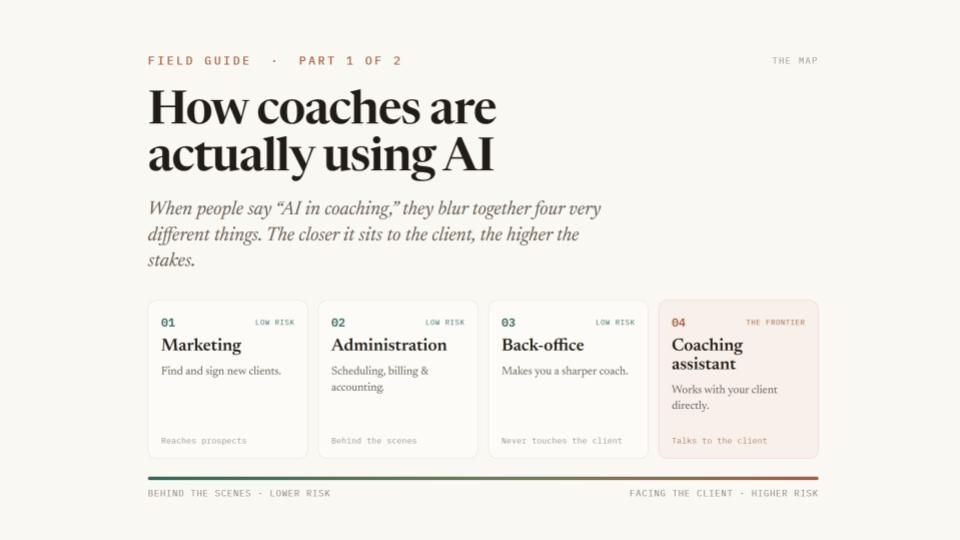
Marketing — using AI to find and sign new clients
Jasper — G2 4.7/5 (~1,270 reviews), Capterra 4.8/5 (~1,851). Enterprise-leaning; brand-voice control.
Copy.ai — G2 4.8/5, Capterra 4.6/5. Go-to-market / workflow automation.
Canva (Magic Studio) — G2 4.7/5 (~6,800), Capterra 4.7/5 (~13,000). Visual content.
ChatGPT (OpenAI) · Claude (Anthropic) · Gemini (Google) — general-purpose; the default at ~$20/mo and what most solo coaches actually use.
Administration — scheduling, billing, accounting
Practice Better — G2 4.8/5 (~290 reviews), Capterra 4.6/5 (~96); strong in nutrition/wellness; entry ~$35/mo.
Healthie — G2 3.9/5 (~21 reviews), Capterra (~96 reviews); free entry tier; pivoting toward enterprise/API.
SimplePractice — established behavioral-health platform (225,000+ practitioners); strong clinical/mental-health documentation. (Confirm current G2/Capterra score on publish.)
Calendly · Acuity Scheduling — best-in-class scheduling, widely adopted.
Paperbell · CoachAccountable · Quenza · Satori — coaching-native practice management.
Coaching back-office — AI notes & session support (never client-facing)
Coaching assistant (emerging) — client-facing AI
This category does not yet have mature G2/Capterra coverage like the others — itself an honest signal that it's nascent. Most client-facing behavior-change AI products are consumer apps rated on the App Store / Google Play / Trustpilot rather than B2B coach tools on G2. Best understood through the outcome and safety evidence in Section 4, not a review-score table.
4. Peer-reviewed & institutional evidence (the deeper reading)
Behavior change & coaching effectiveness
Supporting Sustainable Health Behavior Change — Mayo Clinic Proceedings: Innovations, Quality & Outcomes (2024). Adherence/maintenance as the documented bottleneck.
Defining digital coaching — Frontiers in Psychology (2023). How digital coaching differs from AI coaching.
Sforzo et al., Compendium of Health and Wellness Coaching (2018) + 2019 Addendum — see Section 1.
Hybrid (human + AI) coaching & outcomes
Systematic review of human / AI / hybrid health coaching — Frontiers in Digital Health (2025), RCSI authors.
2025 review of AI behavioral coaching (obesity): retention 57–92%, strongest in hybrid models.
Skeptic's anchor: Vaccaro et al. (2024), meta-analysis of 100+ studies — human-AI combinations can underperform either alone on judgment-heavy tasks.
AI safety & risk (most relevant to Part 2)
American Psychological Association health advisory on AI chatbots / wellness apps (November 2025) — APA press releases.
Stanford (HAI) research on chatbot crisis response (2025) — chatbots failed safe responses ~20% vs ~7% for human therapists.
Brown University (2025) — 15 ethical risks of LLM "counselors."
Illinois (IDFPR) AI-therapy legislation (August 2025); FDA mental-health-AI advisory panel (autumn 2025).
Data-protection references (cited in Part 1)

Comments